For more articles like this one, subscribe to her Substack channel Italy Writers and get in touch via Sunflower Publishing. Privacy policy.
The Invention of a Surname
Here’s something I didn’t know until fairly recently. My surname, worn proudly for twenty-two years of marriage, was never actually Italian. I’d married into a second-generation Italian family and, as is customary in the UK, dropped my maiden name for my husband’s. It took years of poking around in his family history for the truth to surface. RIDOLINI, the name I’d carried all that time, was made up.
Di cosa stai parlando? (What are you talking about?)
How It All Started
Picture a freshers party at Liverpool University, halls of residence, me at eighteen. That’s where I met Romano Ridolini, a second-generation Italian studying zoology. I fell hard and fast. Regular readers will already know my weakness for anything Italian. God knows why. A girl from Lancashire has no business being this obsessed with a whole country, yet here we are.
Romano’s father, Alfonso Ridolini, was actually born in Wales. His own father was Italian by blood but had never spoken a word of the language, despite looking (and apparently singing) like Mario Lanza. His mother was English through and through. As for Romano and me, fate stepped in that night, helped along by a fair bit of alcohol and whatever feminine charm I could muster, and by the end of it he’d proposed. Italy itself stayed out of reach for years afterward. Marriage, kids, a career, they all pushed the trip further down the list, and it sat there unfulfilled for a long time.
Divorce eventually reshuffled things. My next partner shared my itch to travel. When he asked where I wanted to go, there was only one answer. Italy. I assumed the country would welcome me home, prodigal daughter and all, since I carried an Italian name. Instead, the moment I landed, nobody had heard of Ridolini. People asked me to spell it out letter by letter, which felt strange given how tightly Italian surnames usually tie to a specific region or dialect. Curious, I searched online. Not one other Ridolini turned up anywhere in the country.
Che cosa? (What?)
Digging Deeper
I got hold of a copy of the marriage certificate belonging to Romano’s grandfather, his nonno, and the details didn’t add up the way I expected. Back in 1916, Alfonso Ridolini married Louisa Russell, a girl from the Welsh Valleys. He was thirty-seven at the time. She was twenty-five. He’d arrived in Wales and lodged with the Russell family before marrying their daughter. Nobody stood as a witness for his side of the family, and neither of his parents appeared anywhere on the document.
That raised more questions than it answered. What could have pushed a man to invent a new surname and leave Italy behind entirely? A fugitive, maybe. Or someone fleeing political or religious persecution. Then there’s the wedding itself, held under the rites of the Church of England, which seems an odd choice for an Italian man of that era, given how strongly Catholicism runs through Italian culture.
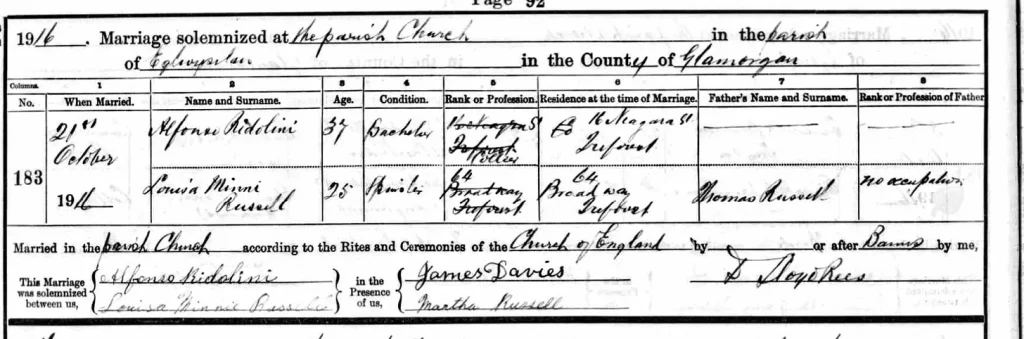
His first name felt different, though. Alfonso got passed down to his own son, following the old tradition of handing a name to the firstborn. That kind of continuity doesn’t usually happen with a fabricated name, so I’m fairly confident Alfonso was real. The surname is where the fiction lives.
And that’s where the search stalled. Once a name can’t be trusted, how do you trace the man behind it?
For a long time I assumed Alfonso hailed from the north of Italy. The evidence disagreed. Ridolini has Germanic Visigothic roots and turns up mainly in Spain and the south of Italy, nowhere near where I’d guessed.
So if it isn’t a real family name from anywhere in particular, where did it come from?
So where did the name Ridolini come from?
Enter Lawrence “Larry” Semon, an American actor, director, producer, and screenwriter active during the silent film era, born in 1889 and gone by 1928. He was a genuine star of physical comedy in his day, though modern audiences mostly remember him now as the man who worked with Stan Laurel and Oliver Hardy separately, before the pair ever teamed up.

Semon had nothing to do with choosing the name himself. Italian film distributors invented it, a stage name dreamed up specifically for the Italian market when his slapstick pictures crossed the Atlantic. It comes from ridere, the Italian verb for laughing or smiling, a nod to his exaggerated grin, chalk-white makeup, and rubbery expressions. Baggy trousers, a derby hat, a memorable moustache, the whole package turned him into a genuine phenomenon across Italy through the 1910s and into the 1920s.
So Why Did Alfonso Take That Name?
Somewhere along the way, Alfonso adopted Ridolini as his own surname, and honestly, I can only speculate why. Something sinister might explain it. Equally, there’s a far more ordinary possibility, that he simply wanted to fit into a new country, sidestep prejudice, or hand people a name they could actually pronounce. Whatever the reason, the trail goes no further, and I doubt I’ll ever get a definitive answer.
The Italians Who Settled in Wales
Wales saw its first real influx of Italian migrants in the late 1800s, driven out of northern Italy’s Apennine region by grinding rural poverty and drawn towards the booming coal and steel jobs of South Wales. The flow of new arrivals continued into the early twentieth century. It’s remembered today as something of a success story, given that Italian cafes and shops had become a fixture of nearly every South Walian town by the 1920s.
A large majority, around eighty percent, traced back to the northern town of Bardi specifically. Much of that came down to the padrone system, a network through which Italians recruited apprentices straight from their home village.
By 1900 or so, roughly a thousand Italians had made Wales home, many working as seamen through ports like Cardiff and Newport, others in adjacent trades such as ship chandlery or dock labour. They brought their food traditions with them, and as the century closed out, the cafes that would define their legacy started opening their doors.
Certain family names became legendary in both Welsh and Italian memory. Sidoli, Bracchi, Antoniazzi, names that spread across the entire country.
From the 1890s onward, cafes, ice cream parlours, and fish and chip shops popped up across the Glamorgan and Gwent valleys and well beyond. Monti’s Cafe served Pembroke Dock. In Aberystwyth, the Antoniazzi family ran the Penguin Cafe near the famous pier.
There was an era when practically every Welsh town had its own Italian-run cafe. Most have vanished now, edged out by global chains, but people still remember them fondly, the shops themselves and the families who kept them running for the communities they served.
Alfonso senior arrived into this world in 1880, part of that generation leaving Italy for a fresh start in a new century. His children included a son, Alfonso Thomas Junior, and two daughters, Rosetta and Lily. All three later married American servicemen after the war and relocated permanently to the United States.
Where the Story Lands
Fast forward to 1957. Alfonso Thomas, twenty-one and selling ice cream for a living, married Ernesta Castellini. She’d left a farming family behind in Piacenza and come to Wales at eighteen. The two of them went on to become my mother-in-law and father-in-law. Looking back, I count myself lucky to have had that Italian thread woven through my life, invented surname and all.
Here’s a video to round things off.