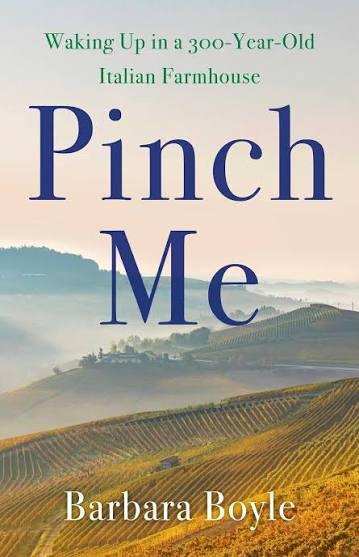
Inside Pinch Me, Barbara Boyle’s memoir of a new life in Piedmont
Wendy reviews books set in Italy. For more articles like this one, subscribe to her Substack channel Italy Writers and get in touch via Sunflower Publishing.
Barbara Boyle was in her fifties, settled in San Francisco, when she and her husband began dismantling a three-hundred-year-old stone barn in the largely unfamiliar region of Piedmont. Pinch Me is her account of what followed, a story that owes something to Under the Tuscan Sun while carving out its own, distinctly personal territory.
The popular image of relocating to Italy tends towards a particular fantasy, vineyards at golden hour, crumbling villas awaiting a loving hand, meals that stretch pleasantly into evening. Boyle’s memoir acknowledges that fantasy while making room for something fuller. The beauty and the food are exactly as advertised. The adjustment, the language, the paperwork and, most strikingly, a breast cancer diagnosis arriving mid-renovation, are given equal space on the page.
The book opens with a direct address to the reader, an invitation into ‘an enchanted life in Italy, where every moment, every bite and every relationship is meant to be enjoyed.’ From there we’re taken to a weekly pasta-making session at the Osteria da Gemma, where women work with techniques inherited across generations, their skill unhurried and entirely their own. Boyle observes a warmth in the room that has nothing to do with commerce, and everything to do with a community doing something it loves.
The narrative then loops back to Boyle and her husband’s honeymoon, when they first encountered Piedmont. Their morning at the Hotel Villa Beccaris, breakfasting in a glass-walled room perched above the valley towards Barolo, becomes the moment the story turns.
‘I did not know what we had stumbled onto,’ Boyle writes, ‘but I knew we had found someplace special. And I knew I wanted more.’
What follows is a familiar tension for anyone who has fallen for a place on holiday, the pull of home against the pull of somewhere else. Boyle weighs the practical and emotional cost of such a move with candour, and it took eighteen months before she returned to Piedmont at all. A chance introduction to a local property agent led her to an abandoned house and barn in the hamlet of Roddino.
‘Tall, proud stone walls and rusted iron doors, broken windows and shutters, crowned with a roof of old terracotta tiles,’ she recalls. ‘I turned to my husband. “This is it.”‘
The purchase, and the years of restoration that follow, form the spine of the book. Permits, architects, builders, seasons passing into other seasons. Boyle threads this practical narrative with the gradual, hard-won acceptance of the local community, and some of the memoir’s finest passages sit here, in shared meals and unhurried evenings with neighbours.
‘There is something in the language of goodwill that is universal,’ she writes of one such evening, ‘passing plates that had been in the family for generations, drinking wine from crystal glasses Biagio had inherited from his grandfather. It was impossible not to feel welcomed, whatever language was spoken.’
Three years in, the couple commit to living in Piedmont full time, and the book’s rhythm shifts to match, unfolding season by season from the moment the house becomes habitable.
Pinch Me earns its place among memoirs of reinvention through the honesty of its telling. Boyle writes with a reflective clarity that gives the book its real weight.
‘Spending time in Italy was teaching me, firsthand, how something as primaeval as eating, as essential as being part of a small community, creates a life,’ she writes. ‘I slow down and truly listen to the sounds around me, savour tastes and smells. I laugh a little more fully, love a little more unguardedly.’
Recipes appear throughout, threaded between chapters rather than appended as an afterthought, lending the book a personal, tactile quality. QR codes link to photographs of the house through its transformation, an unexpected and effective touch that lets the reader watch the story take physical shape.
Pinch Me is a memoir written with genuine feeling, and it reads that way from the first page to the last.
Why I recommend this book
Plenty of memoirs trace the well-worn path of an expat falling for Italy and building a new life there. Pinch Me stands apart through the honesty of its telling and the momentum of its storytelling, scenes of daily life set against passages of genuine reflection.
‘Living life like this, more slowly, more purposefully and more enjoyably, changes who I am,’ Boyle writes, and the observation carries real weight given everything the reader has already witnessed her navigate.
Boyle’s narrative voice stays steady and open throughout, even as the story moves through setbacks and a health scare that reveals a vulnerability most readers will recognise in themselves. As someone who has made a similar move abroad, I found the parallels quietly affecting.
The recipes woven through each chapter add a further layer of intimacy, small culinary memories offered up alongside the larger story. My own copy arrived signed, with a bookmark and a set of cards bearing photographs from the book, a generous gesture that matched the spirit of the writing itself.
This is a masterclass in memoir, rich in sensory detail and carried by an emotional honesty that lingers well after the final page.

This article was adapted from my original review published on Italy Writers.