A Walk Through One of the Roman World’s Best Preserved Cities
This article was adapted from original ideas published on Visit Naples and Amalfi coast Travel tips.
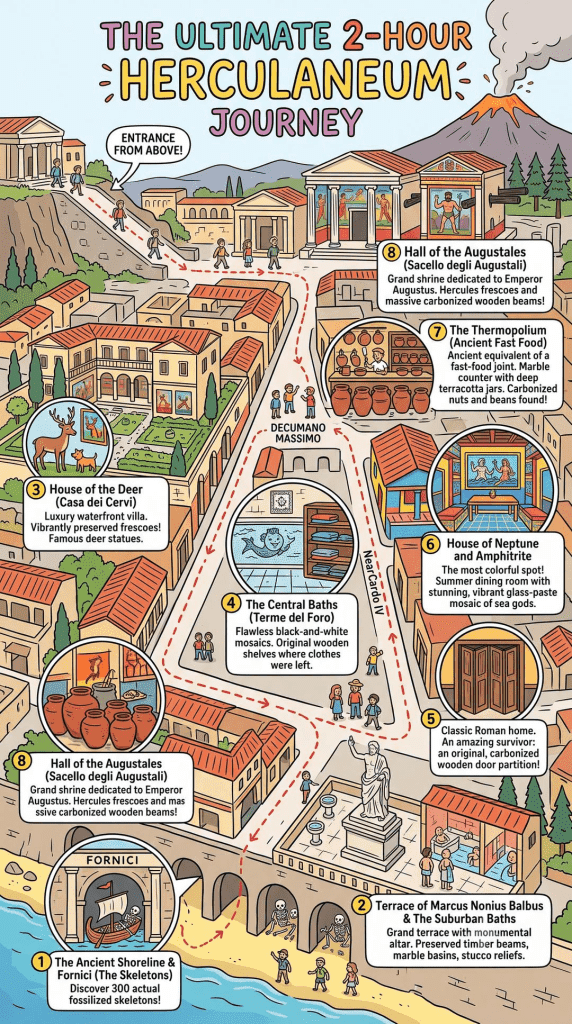
Herculaneum offers a different perspective on life in the Roman world. Smaller than nearby Pompeii and remarkably well preserved beneath volcanic mud, it allows visitors to explore elegant homes, public baths and bustling streets within a comfortable walking route. Over the course of around two hours, this self-guided walk reveals the city’s remarkable preservation while offering insight into the people who once lived here.
Beginning at the Ancient Shoreline
Although visitors enter the archaeological site from the modern town above, the journey into Herculaneum begins at sea level. A gently descending walkway leads towards the ancient city, offering wide views across the excavations before passing through a tunnel carved into volcanic rock. Emerging beside the ancient shoreline provides a memorable introduction to a city frozen in time by the eruption of Mount Vesuvius in AD 79.
The Fornici and the Ancient Beach
The first stop brings you to the row of vaulted boat houses, known as the fornici, which line the former coastline.
Here, archaeologists uncovered the remains of over 300 people who had gathered by the sea in the hope of escaping the eruption. Unlike Pompeii, where plaster casts recreate the victims’ final moments, Herculaneum preserves their skeletal remains. The intense heat of the pyroclastic surge claimed lives almost instantly while allowing the bones to survive beneath layers of volcanic material.
The discovery remains one of the most moving experiences within the archaeological park and offers a powerful reminder of the human story behind the ruins.
The Terrace of Marcus Nonius Balbus and the Suburban Baths
A short walk uphill leads to the terrace dedicated to Marcus Nonius Balbus, one of Herculaneum’s most influential citizens. His statue and memorial overlook the ancient shoreline, reflecting the prestige he held within the community.
Beside the terrace, the Suburban Baths provide one of the finest examples of Roman engineering and preservation. The volcanic mud protected timber ceilings, marble basins and decorative stucco with exceptional care. Visitors can still appreciate details that would normally have disappeared over two thousand years.
The House of the Deer
Among Herculaneum’s grandest residences, the House of the Deer overlooks what was once the Bay of Naples. Spacious terraces and refined reception rooms suggest the lifestyle of a prosperous Roman family.
The villa takes its name from marble sculptures depicting deer pursued by hunting dogs, discovered within its gardens. Frescoes throughout the property retain striking colour, offering a vivid impression of Roman domestic decoration.
Exploring the Public Baths
The Central Baths stood at the heart of daily life in Herculaneum. Separate facilities served men and women, each equipped with heated rooms, cold pools and changing areas.
One of the finest surviving features appears in the women’s baths, where a black and white mosaic depicting Triton still decorates the floor. Wooden shelving, preserved through carbonisation, offers another rare glimpse into the routines of Roman society.
The House of the Wooden Partition
Few archaeological sites preserve ancient wood as successfully as Herculaneum.
Inside the House of the Wooden Partition, visitors encounter an original folding timber screen that once divided the family’s private quarters from the public reception area. Carbonised by the eruption rather than destroyed, the partition still retains its brass fittings and demonstrates the remarkable conditions created by the volcanic mud.
The House of Neptune and Amphitrite
One of the city’s finest artistic treasures awaits nearby.
The House of Neptune and Amphitrite is celebrated for its colourful glass-paste mosaic portraying the sea god Neptune alongside Amphitrite. Decorating an elegant summer dining room, the artwork remains remarkably vibrant after almost two millennia.
This residence illustrates the level of craftsmanship enjoyed by affluent households in Herculaneum and continues to be one of the site’s most photographed locations.
A Roman Street Food Stop
Roman cities embraced quick meals just as modern cities do today.
The ancient thermopolium preserves its marble service counter together with large terracotta jars once used to hold prepared food and drink. Excavations uncovered carbonised food remains alongside wooden display shelves, providing valuable evidence of everyday commerce and dining habits.
The Hall of the Augustales
The walk concludes at the Hall of the Augustales, a sanctuary dedicated to the imperial cult and maintained by prosperous freedmen.
Its frescoes depicting Hercules among the gods reflect the city’s legendary origins, while enormous carbonised roof beams reveal the extraordinary force of the volcanic surge that swept through Herculaneum during the eruption.
The building serves as a fitting final stop, bringing together religion, civic life and the dramatic events that shaped the city’s history.
Completing the Story at the National Archaeological Museum of Naples
Many of Herculaneum’s finest discoveries are displayed today in the National Archaeological Museum of Naples, often referred to as MANN. Frescoes, bronze sculptures from the Villa of the Papyri and the famous carbonised papyrus scrolls provide valuable context for the places explored within the archaeological site.
Visiting the museum after Herculaneum allows the story of the city to continue beyond its streets, revealing the artistry, craftsmanship and daily lives of the people who once called it home.
A Journey That Brings Ancient Rome Into Focus
Herculaneum rewards visitors with an experience that feels both intimate and remarkably complete. Its compact layout allows time to appreciate elegant homes, public buildings and everyday spaces without rushing from one landmark to another. Together, they offer one of the clearest windows into Roman life anywhere in Italy, making Herculaneum an essential stop for anyone seeking to understand the enduring legacy of the ancient world.