Discovering Positano from Hilltop to Shore
This article was adapted from original ideas published on Visit Naples and Amalfi coast Travel tips.
Positano is often admired for its colourful houses tumbling towards the sea, yet its character reveals itself gradually as you walk through its winding streets. Built into the cliffs of the Amalfi Coast, the village rewards those who explore on foot, where every staircase, terrace and narrow lane offers another perspective of daily life shaped by the landscape.
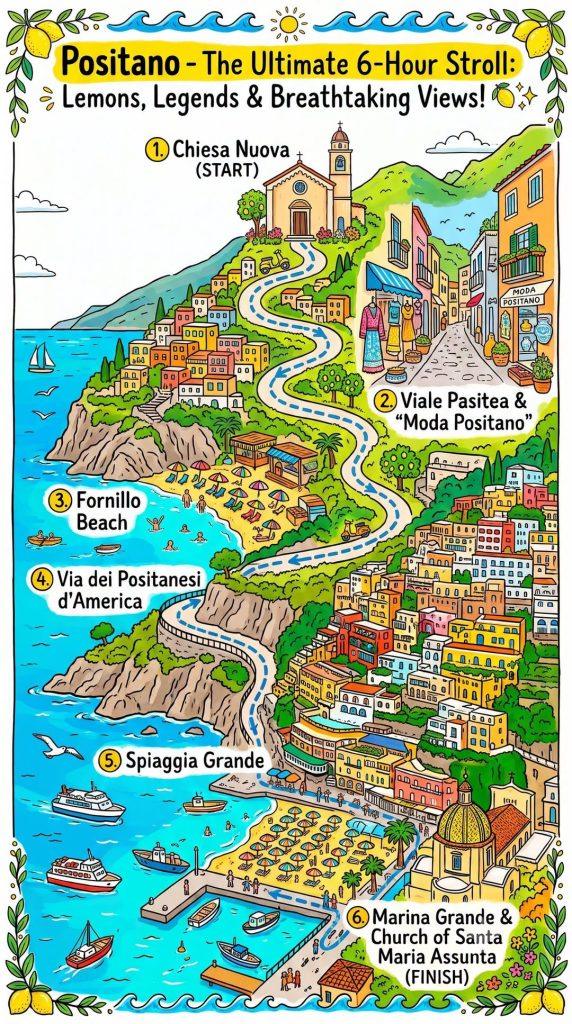
This self-guided walk follows a gentle downhill route from Positano’s upper neighbourhoods to the waterfront. Lasting around six hours at a relaxed pace, it combines historic landmarks, panoramic viewpoints, quiet beaches and local traditions while allowing plenty of time to pause and appreciate one of Italy’s most recognisable coastal towns.
Starting Above the Village
The walk begins at Chiesa Nuova, positioned high above the centre of Positano. Dating back to the eleventh century, the church was originally dedicated to Our Lady of Graces and has long marked the upper edge of the historic village.
Its unusual elliptical design sets it apart from many churches along the Amalfi Coast. From here, visitors are treated to wide views of pastel-coloured houses cascading towards the Mediterranean, offering an ideal introduction to Positano’s dramatic setting.
Walking Along Viale Pasitea
Leaving Chiesa Nuova behind, the route follows Viale Pasitea, the village’s main road and one of Positano’s most characteristic streets.
For centuries, Positano could only be reached by sea or by steep mule tracks crossing the hills. Roads suitable for wheeled transport arrived much later, transforming access while preserving the village’s distinctive vertical layout.
Today, Viale Pasitea is lined with independent boutiques, artisan workshops and cafés. It also tells the story of Moda Positano, the relaxed style that emerged during the 1950s. Linen garments, handmade leather sandals and colourful fabrics continue to define a fashion tradition inspired by the Mediterranean climate and the region’s famous lemons.
Those wishing to pause along the way will find several artisan gelaterias, making this an enjoyable stop before continuing downhill.
A Quieter Side of Positano at Fornillo Beach
Hidden beyond a series of stone steps, Fornillo Beach offers a peaceful alternative to the lively waterfront.
Its name is believed to derive from the Italian word for a small oven, recalling local traditions that connect the area with Emperor Tiberius during his time on nearby Capri. Whether legend or history, the story reflects the deep cultural connections shared across the Bay of Naples.
During the twentieth century, Fornillo became a favourite retreat for artists, writers and creative minds drawn to its quieter atmosphere. Even today, it offers a welcome contrast to Positano’s busiest areas, with calm waters framed by dramatic cliffs.
Following the Coastline
From Fornillo, the route continues along Via dei Positanesi d’America, a scenic coastal path linking the beach with Marina Grande.
The walkway commemorates the many families who left Positano for America during the late nineteenth and early twentieth centuries in search of new opportunities. Their legacy remains an important chapter in the town’s history.
Along the path stands Torre Trasita, one of several medieval watchtowers built to protect the coastline from pirate raids. Looking out across the sea, it serves as a reminder of a time when these waters required constant vigilance.
The Heart of Positano at Spiaggia Grande
As the path reaches Spiaggia Grande, the atmosphere changes once again.
For centuries, this beach served as Positano’s principal harbour, connecting the village with ports throughout the Mediterranean during the height of the Amalfi Republic. Merchant vessels once departed from these shores carrying goods across southern Italy and beyond.
Today, Spiaggia Grande remains the social heart of Positano. Cafés, restaurants and beach clubs line the waterfront, while the sweeping view back towards the colourful hillside has become one of Italy’s most photographed scenes.
Santa Maria Assunta and Marina Grande
A short walk from the beach leads to the Church of Santa Maria Assunta, one of Positano’s most recognisable landmarks.
The church is home to a Byzantine icon of the Black Madonna, surrounded by one of the village’s best-known legends. According to local tradition, pirates carrying the icon were caught in a violent storm until a mysterious voice instructed them to “Posa, posa”, meaning “put it down”. They left the icon in Positano, giving rise to the town’s name according to local folklore.
Above the church, the colourful majolica dome has become an enduring symbol of the Amalfi Coast. Its yellow and green tiles echo the surrounding landscape, reflecting both the region’s celebrated lemon groves and the Mediterranean vegetation covering the hillsides.
Enjoying the Evening in Positano
Visitors spending the evening in Positano may wish to continue their experience with dinner overlooking the village or a relaxed drink as the sun sets across the sea.
Long-established local restaurants continue to celebrate traditional cuisine prepared with regional ingredients, while elegant terraces provide memorable views across Marina Grande. Those looking to unwind beside the water may also enjoy one of the nearby beach clubs, easily reached from the harbour.
A Village Best Explored on Foot
Positano reveals its character gradually, rewarding visitors who take time to slow their pace and explore beyond the viewpoints. From centuries-old churches and quiet beaches to artisan boutiques and panoramic coastal paths, each part of the village contributes to a story shaped by history, culture and the sea.
Walking from the upper streets to the shoreline offers one of the most rewarding ways to experience Positano, allowing every staircase and hidden corner to become part of the journey itself.