A reading journey through a landscape shaped by memory, resilience, and everyday life
Wendy reviews books set in Italy. For more articles like this one, subscribe to her Substack channel Italy Writers and get in touch via Sunflower Publishing.
There is a particular way of travelling through Italy that begins with a book. It does not follow a fixed route, nor does it rely on landmarks alone. Instead, it moves through voices, places, and moments that stay with you long after the final page.
This journey turns south to Basilicata, a region that often sits outside the usual itinerary. It is defined by its distance from the obvious, both geographically and culturally. What it offers instead is something quieter and more enduring.


A Region Shaped by Landscape and History
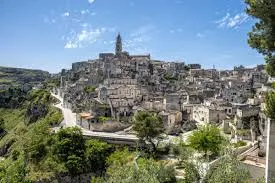
Basilicata stretches between mountains and sea, bordered by Campania, Apulia, and Calabria. Its terrain is rugged and, in many places, untouched. Hill towns rise from the landscape with a sense of permanence, shaped by centuries of continuity rather than change.
The region was once known as Lucania, a name that still carries weight in its identity. Traces of the past remain visible, from prehistoric settlements to the cave dwellings of Matera. The capital, Potenza, reflects a different rhythm, where older structures sit alongside a more modern pace of life.
There is a strong sense that time moves differently here. Traditions remain intact, and daily life continues with a steadiness that feels rooted rather than preserved.
Why Basilicata Works So Well in Literature
As a setting, Basilicata offers more than scenery. Its isolation, history, and social structure create a framework for stories that explore endurance, displacement, and belonging.
The villages, often set apart from one another, carry their own histories. Relationships extend across generations, shaped by events that are not always spoken about directly. This lends itself naturally to narratives that move between past and present.
Writers return to this region for its depth. It allows space for reflection and for stories that unfold gradually, grounded in place and character.
Books That Bring Basilicata to Life
Finding Marco by Kenneth C. Cancellara
This novel follows Mark Gentile, a man who has built a life defined by ambition and professional success. After stepping away from his career, he returns to Acerenza, the village where he spent his childhood.
What begins as a pause becomes something more considered. The landscape, familiar but changed, prompts reflection rather than nostalgia. His time among vineyards and old friendships offers a different way of understanding success, one that is not measured in the same terms as before.
The novel moves at a reflective pace, allowing space for the internal shift that takes place as Mark reconnects with his past.
Murder in Matera by Helene Stapinski
In this memoir, Helene Stapinski traces a story that begins long before her own lifetime. What she knows at the outset is incomplete, shaped by family stories that feel exaggerated and unresolved.
Her search takes her to Basilicata, where the past is still accessible, though not always easily. The process unfolds over years, marked by persistence and moments of unexpected clarity.
The book combines personal narrative with investigative depth. It captures the complexity of uncovering a history that resists simple conclusions.
Under Italian Skies by Nicky Pellegrino
This story begins with a life that has quietly come undone. Stella, after years of stability, finds herself without direction following the sudden loss of her employer.
A house exchange brings her to southern Italy, where the pace of life and the setting begin to shift her perspective. What starts as a temporary change gradually becomes something more immersive.
The novel explores how place can influence identity, particularly when it allows for a different way of living.
Christ Stopped at Eboli by Carlo Levi
Carlo Levi’s account of exile in southern Italy remains one of the most defining works connected to this region. Writing about his time in a remote village during the 1930s, he describes a community that exists on the margins of the state.
The title reflects a local expression, one that captures the sense of abandonment felt by those living there. Levi’s observations are detailed and unembellished, focusing on the realities of daily life.
The result is a work that continues to shape how Basilicata is understood, both historically and culturally.
Seasons in Basilicata by David Yeadon
This travel memoir follows a year spent in the hill village of Aliano. What begins as a short stay becomes a deeper engagement with the rhythms of local life.
The narrative moves through seasons, marked by agricultural cycles, festivals, and routines that define the year. There is a clear awareness of the region’s literary history, particularly its connection to Carlo Levi.
At the same time, the book remains grounded in present experience, observing how much has endured.
In the Kitchen
Basilicata’s cuisine is a rustic, “peasant-style” Mediterranean tradition centred on pork, lamb, legumes, and handmade durum wheat pasta, famously using peperoni cruschi (sweet, fried dried peppers) and Lucanica sausage. Dishes like Peperoni Cruschi: Sun-dried, deep-fried red peppers from Senise, often called “Lucanian gold,” served as a snack or side or Pasta Mollicat, a staple dish of pasta tossed with a sauce made from oil, anchovies, garlic, and crispy breadcrumbs.
Flavours of Basilicata by Federazione Lucana D’America
This recipe book of traditional Lucanian dishes and cuisine provides cooks with a taste of authentic foods from the Basilicata region of Italy.
Eat and Love Basilicata: The Basilicata Cookbook by Aldo Giannini
A cookbook, written in English language, offering all the essential recipes of the most popular dishes of the Italian region of Basilicata.
Basilicata: A Rough Land with a Heart of Gold by Irina Sambor
This book is a journey through Basilicata’s culinary heart:


I hope you enjoy my choice of books! See you in the next region soon.
This article was adapted from my original review published on Italy Writers.