From the Amalfi Coast to Lake Iseo and the ancient villas outside Rome, the locations behind Netflix’s upcoming romantic caper
Shock! Horror! A romantic caper filmed far beyond Positano
There is something slightly cheeky about the movie title Positano. The town gives the Netflix film its name – most likely for marketing purposes – and the production did spend time on the Amalfi Coast, but much of the shooting took place elsewhere in Italy.
Directed by Academy Award winner Daniel Roher, Positano brings Matthew McConaughey and Zoe Saldaña together as rival jewel thieves who are forced to work together on a major heist. Netflix describes McConaughey’s character as a charming jewel thief who gives up his old life to help a mysterious woman, played by Saldaña, pursue a score worth considerably more than money.
The production ran for eleven weeks, from May to July 2026, with Italy’s national film-location database recording sets in Positano, Lake Iseo and Rome. The largest share of the shoot was in Lazio, followed by Lombardy, with only twelve shooting days recorded in Positano itself.
That makes the film an interesting journey through three very different Italian landscapes. The Amalfi Coast supplies the obvious glamour. Lake Iseo provides a quieter northern setting, while Rome and Tivoli bring in grand architecture and the slightly theatrical scale that a jewel-heist story needs.
This itinerary follows the publicly documented filming locations rather than attempting to assign individual scenes where Netflix has yet to do so.
Netflix Tudum’s official guide to Positano
Day One on the Amalfi Coast, where Positano begins
Source: Tripadvisor
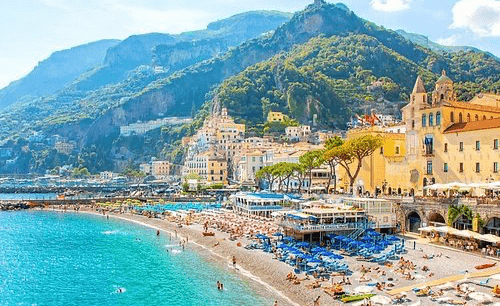
The film’s title location is the obvious starting point, but the production began slightly further along the coast. The first reported filming took place in Praiano, before the production moved through the Amalfi Coast and into Positano. Local officials confirmed that filming in Praiano started on 8 May 2026. They mentioned that filming took place around Via Lama, Marina di Praia Via Roma and the Amalfi Coast road.
Praiano is special because it does not look like the crowded postcard image of the coast. The village climbs up the rock above the sea. There are stairways, tiny lanes and houses spread across the cliff. From Praiano Positano is across the coast not below you. That view gives the landscape a sense of depth that you cannot get from within the town itself.
Walk down toward Marina di Praia, the cove, under the village. Then walk back uphill through Praiano before heading toward Positano. The road itself is part of the experience. The SS163 is one of the defining pieces of Amalfi Coast geography, with the mountains repeatedly forcing the road between cliff and water.
By the time you reach Positano, the landscape becomes more compressed. The town is built almost entirely into the slope, with lanes, staircases and terraces dropping towards the Marina. This is the Italy that the film’s title promises, although the production database records only twelve shooting days here.
Early reports from the set also placed filming on the water around Salerno, with McConaughey photographed aboard a boat alongside Roher.

Source: What’s on Netflix
The point of the day is therefore less about hunting for one exact doorway and more about understanding the visual territory the film had available: steep streets, boats, terraces and a coastline where movement between land and sea is part of everyday life.
Why go
Positano works well because Positano uses one of Italys most recognisable landscapes without being confined to the landscape. If you start your trip, in Praiano you get to see the side of the same coastline before you finally arrive in the town that gives the film its name.
Where to stay
Google ratings and review counts checked August 2026, figures may change.
- Hotel Miramare, (4.6 stars from 168 Google reviews) positioned above Positano with access to the historic centre. The best of both worlds, close enough to wander into town, but far enough away when you’ve had enough with crowded places.
- Hotel Vittoria Positano,(4.5 stars from 182) near Fornillo and suited to a base away from the busiest part of town. If you prefer a quieter setting and would rather end the day away from the stretch of the town this is a good fit.
- Hotel La Bougainville Positano, (4.6 stars from 217) a property close to the centre and the stairways leading down towards the Marina. Useful for anyone who plans to spend most of the day out exploring and wants to be right in the middle of things when they return.
The stays around Positano were chosen to give you a few ways to experience the town from being close to the centre to having a quieter base, near Fornillo. After a day of walking the coast and climbing Positano’s stairways having somewhere comfortable to retreat to feels especially worthwhile.
Where to eat
- Da Vincenzo Positano,(4.5 stars from 2,327) a long-established address near the centre. For a first evening on the coast, it is the sort of place that makes settling into Positano’s food scene feel easy. A good place to start if you want dinner somewhere with a bit of history behind it, rather than simply picking the restaurant with the best view.
- Ristorante Don Giovanni,(4.7 stars from 3,387) on Via Cristoforo Colombo, with the elevated position that makes this part of Positano so visually distinctive. If dinner with a view is high on the list, this is the one to linger over. This is the one to choose when dinner with a view sounds better than eating in a hurry and moving on.
- Restaurant da Pupetto, (4.6 stars from 196) down near Fornillo beach for a meal closer to the water. For an evening when the beach sounds more appealing than another climb through town, this is a natural choice.
The food choices make the first day a great mix of classic Positano, dinner with a view and a more relaxed option down by Fornillo beach. It keeps the evening flexible depending on whether you want to stay in the middle of town or get closer to the water.
Getting there
The Amalfi Coast is easiest with a car and driver, although buses and boats connect the principal towns. In high season, traffic and parking can be difficult, and Italy’s official tourism site recommends public transport or sea connections when possible.
Days Two and Three on Lake Iseo, the northern Italy of the film
Source: Visit Lake Iseo
The biggest surprise in the production is Lake Iseo.
It is several hundred kilometres from Positano and visually belongs to a different Italy altogether, so factor in a day for travel time, whether you drive or take a combination of public transport options.
The lake sits between Lombardy’s mountains, with small waterfront towns, wooded slopes and Monte Isola, the large inhabited island rising from the centre of the lake.
The production spent eighteen shooting days in the Lake Iseo area, considerably longer than it did in Positano. Movie Walks identifies Villa della Solitudine on Monte Isola as one of the principal locations.
This is where the itinerary becomes less about famous views and more about the texture of a place.
Begin in Iseo, the lakeside town on the southern shore. Its old centre is compact enough to explore on foot, while the waterfront opens towards the mountains. From here, take the boat across the lake towards Monte Isola.
The island is car-free apart from authorised vehicles, which changes the pace immediately. Villages are connected by narrow roads and paths that follow the shoreline and climb into the hills.
The production also filmed around Tavernola Bergamasca and Iseo in May. Local reports recorded an action sequence in Tavernola and later filming in Iseo, while production activity moved to Monte Isola for scenes at Villa della Solitudine.
Villa della Solitudine is the most distinctive documented filming site here. It sits on Monte Isola, giving the production a setting that is almost the opposite of the Amalfi Coast: water surrounding the location, mountains behind it and a much quieter northern landscape.
Walk through the island’s villages before heading towards the villa area, then return to the lake shore for the late afternoon. The light changes quickly here, with the mountains turning into silhouettes as the sun drops behind them.
Why go
Because Lake Iseo explains why the production needed Italy beyond the title location. It gives the film another visual language entirely: northern lakes, mountain horizons and an island setting that can stand in for somewhere far removed from the Amalfi Coast.
Where to stay
- Iseolago Hotel, (4.3 stars from 935) outside the centre of Iseo, with gardens, a spa and easy access to the lake.
- International Hotel, (4.1 stars from 399) a practical base in Iseo itself if you prefer to remain within walking distance of the town.
For Lake Iseo, the choices are deliberately a little slower after the energy of the Amalfi Coast. One gives you gardens and a spa outside town, while the other keeps you within walking distance of Iseo for an easier evening.
Where to eat
Stay around Iseo for the evening rather than trying to return to the coast. The town is surrounded by the Franciacorta wine region, making local wine and Lombard cooking the natural continuation of the day.
Getting there
A car makes the most sense for this section, particularly if you want to visit both Iseo and Tavernola Bergamasca. Monte Isola itself is reached by ferry from several points around Lake Iseo.
Italy for Movies’ official Positano filming-location record
Days Four and Five in Rome and the villas of Tivoli

Source: Walks of Italy
The final days are another trek south again absorbing much of day four, this time into Lazio, where the production spent its longest period.
Italy for Movies records thirty-six shooting days in the Rome area, including Rione Testaccio, Villa Adriana in Tivoli and additional work at Rome’s Cinecittà studios.
Rome is where the itinerary becomes less literal.
The film is a jewel-heist story, and the city’s historic centre offers the architectural scale that the other locations cannot. Rather than treating Rome as one large filming location, concentrate on Testaccio and then travel east to Tivoli.
Rione Testaccio is one of Rome’s more lived-in districts, built around the ancient Monte Testaccio and the former industrial riverfront. Its streets have a very different character from the monumental centre, which makes it useful for a production moving between private lives, urban movement and the grandeur of a heist.
Then leave Rome for Tivoli, around 30 kilometres east of the capital.
Here the production used Villa Adriana, Hadrian’s immense ancient residence. The complex covers roughly 120 hectares and contains palaces, baths, theatres, gardens, fountains and monumental pools. It has been a UNESCO World Heritage Site since 1999.
The choice makes cinematic sense without requiring us to invent a scene. Villa Adriana was built to impress. Its scale, courtyards, water features and ruined architecture give a film an immediate sense of wealth and history.
The production was officially scheduled to film at Villa Adriana from 15 to 19 June 2026, with evening and night shoots.
That timing is worth noting. A site that can feel overwhelmingly bright during the day becomes something else after sunset, when artificial light picks out individual structures and the ancient complex becomes almost theatrical.
Villa d’Este is therefore worth adding even though Italy for Movies’ main location record specifically lists Villa Adriana. Its gardens, terraces and fountains provide a natural continuation of the grand architectural world around Tivoli.
Why go
Because Tivoli gives the itinerary its strongest change of scale. After the compressed streets of Positano and the open water of Lake Iseo, Villa Adriana is deliberately monumental.
Where to stay
Remain in Rome if you want the easiest base for the full itinerary.
Hotel Artemide (4.8 stars from 2,013) is a central option with straightforward access to the historic centre and transport connections towards Tivoli.
For a more atmospheric evening, Tivoli itself makes a good alternative, particularly if you want to see the historic town after the day visitors leave.
Where to eat
- Roscioli Salumeria con Cucina (4.3 stars from 6,471) in central Rome for a more substantial Roman dinner.
- Armando al Pantheon (4.4 stars from 2,173) for traditional Roman cooking in one of the city’s historic dining settings.
- Ristorante Sibilla in Tivoli (4.7 stars from 2,187) if you decide to stay for dinner after the villas.
The Rome and Tivoli choices were picked to suit the final days of the trip, with traditional Roman cooking in the city and a Tivoli option for anyone who stays after visiting the villas. It also means the food follows the route rather than adding unnecessary detours.
Getting there
Villa Adriana is accessible from Rome by public transport, although a car makes it easier to combine Tivoli with other locations. The official Tivoli tourism site places the town around 30 kilometres from Rome and provides current information on reaching it by train, bus or car.
Villa Adriana official visitor information
For completists
The production’s Italian footprint is broader than the three-day route suggests, but these are the locations that can currently be documented with reasonable confidence.
The national Italy for Movies database records Positano in Campania, Lake Iseo in Lombardy and Rome in Lazio, with the latter including Villa Adriana and Rione Testaccio. It records eleven weeks of filming and a production crew of approximately 530 people.
There are also reports of filming at Cinecittà in Rome, while Villa d’Este in Tivoli confirmed preparations for the production.
What remains unclear is which exact location corresponds to which finished scene. The film has yet to be released, and Netflix has published the broad story and cast information rather than a scene-by-scene location guide. It is therefore better to treat these as documented filming locations than to claim that a particular terrace, road or building appears in a particular sequence.
Positano is expected to premiere in 2027, although an official release date has yet to be announced.