Oplontis and the Villa Time Forgot
This article was adapted from original ideas published on Visit Naples and Amalfi coast Travel tips.
Most visitors arrive in Campania with the same archaeological checklist.
Pompeii.
Herculaneum.
Mount Vesuvius.
Few realise that one of the region’s most remarkable Roman sites sits quietly between them.
Its name is Oplontis.
And unlike Pompeii, where crowds move through ancient streets in search of famous landmarks, Oplontis offers something different. Here, the story is not about an entire city. It is about a single villa and the people who once lived within its walls.
The result feels surprisingly intimate.
The Day Everything Stopped
In AD 79, Mount Vesuvius erupted and changed the Bay of Naples forever. Entire communities disappeared beneath volcanic ash. Streets vanished. Buildings collapsed. Lives ended in an instant.
At Oplontis, however, the story appears to have unfolded differently.
Archaeologists believe the vast Villa of Poppaea may have been undergoing repairs following years of earthquake damage. When excavations began, they discovered something unexpected. There was almost no furniture. Doors were missing. Parts of the villa appeared unfinished.
The evidence suggested absence rather than panic. The villa was waiting for people to return. They never did.
Buried beneath metres of ash and pumice, the property remained untouched for centuries, preserving colours, decorations and architectural details that still feel remarkably alive today.
The Villa Linked to Nero’s Wife
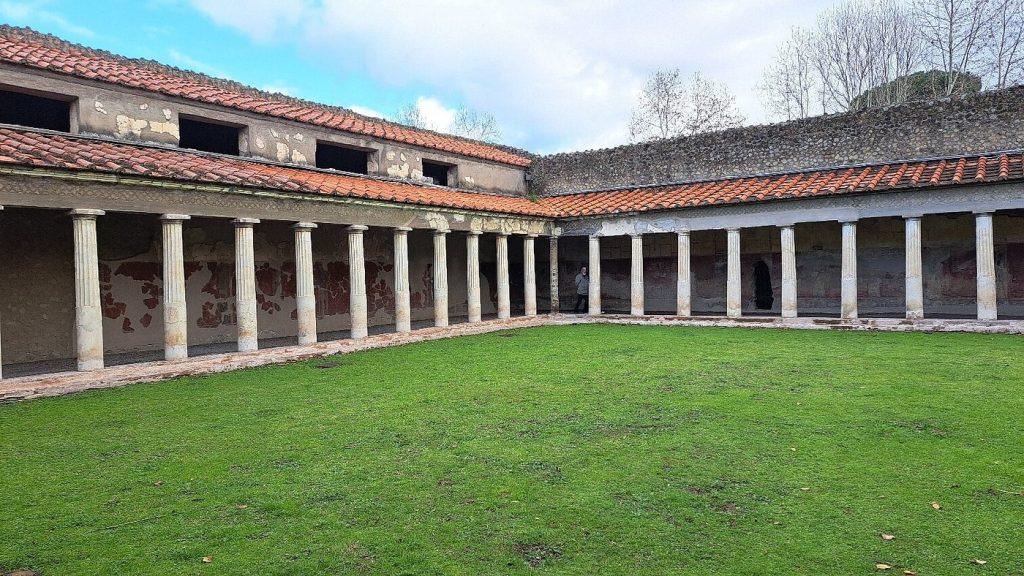
The jewel of Oplontis is Villa A, widely associated with Poppaea Sabina, the second wife of Emperor Nero.
Whether she personally spent long periods here remains uncertain. The luxury does not.
The villa was designed on a scale few people in the Roman world could afford. Grand courtyards opened onto gardens. Long porticoes framed views across the estate. Private baths, reception rooms and one of the largest swimming pools found in a Roman residence transformed the property into a statement of wealth and status.
This was not a retreat from power. It was an extension of it.
The Frescoes Everyone Talks About


Most archaeological sites impress through scale.
Oplontis impresses through detail.
The frescoes remain among the finest examples of Roman wall painting ever discovered. Walk through the villa and the colours still command attention. Deep reds, elegant blacks and intricate decorative scenes survive with a clarity that often surprises first-time visitors.
Many paintings use trompe l’oeil techniques to create architectural illusions. Columns appear where there are none. Windows seem to open onto distant landscapes. Objects look close enough to touch.
The Romans understood visual storytelling long before the phrase existed.
Beauty, Vanity and Roman Legend
Oplontis is also home to some of the more colourful stories associated with imperial Rome.
Ancient writers claimed that Poppaea Sabina maintained a herd of hundreds of donkeys so she could bathe in their milk. Whether the number was exaggerated hardly matters. The story survived because it perfectly captured the image of Roman luxury taken to its extreme.
Elsewhere, frescoes depicting elaborate desserts continue to fascinate historians. One painting bears a striking resemblance to modern Sicilian cassata, a reminder that sophisticated culinary traditions existed long before anyone thought to document them on social media.
Sometimes the distance between ancient Rome and modern Italy feels surprisingly small.
The Other Oplontis
Not every story here is about wealth.
A short distance from Villa A stands Villa B, a commercial complex connected to trade and storage. Here archaeologists uncovered one of the most moving discoveries from the eruption.
Fifty-four people were found gathered together near the shoreline. Many still held jewellery, coins and valuables. They had chosen what they hoped to save and waited for rescue that never arrived.
The contrast is striking. One villa survived because it was empty. The other preserves the final moments of people who stayed.
Why Oplontis Feels Different
Part of Oplontis’ appeal comes from what it lacks.
It lacks crowds. It lacks tour groups moving shoulder to shoulder through narrow streets. It lacks the pressure to rush from one famous landmark to the next. Visitors often spend more time looking and less time navigating. That changes the experience.
You begin noticing painted details. Garden layouts. Architectural choices. Small things that are easily missed when thousands of people share the same space.
Planning Your Visit


Reaching Oplontis is surprisingly straightforward.
The Circumvesuviana railway connects Naples, Pompeii, Torre Annunziata and Sorrento. Exit at Torre Annunziata Oplonti station and the archaeological site is only a short walk away.
Spring and autumn offer the most comfortable conditions, particularly between April and May and again in October and November. Summer remains popular, although temperatures can become intense in exposed areas of the site.
Unlike Pompeii, which can easily consume an entire day, Oplontis rewards a slower visit of around ninety minutes.
That is usually enough. The villa reveals itself gradually.
What Not to Miss
- The grand atrium remains one of the finest introductions to Roman decorative art.
- The thermal baths showcase the sophistication of Roman engineering and daily life.
- The gardens help visitors understand how the estate was originally experienced.
- Then there is the swimming pool.
Stretching more than sixty metres in length, it remains one of the clearest expressions of the villa’s original ambition. Looking across it today, it becomes easier to imagine the scale of the world that once existed here.
Continue the Story in Naples
Many of the sculptures and decorative treasures discovered at Oplontis are no longer on site. They now reside inside the National Archaeological Museum of Naples. Visiting both locations creates a far richer experience.
The villa provides the setting. The museum provides the objects.
Together they reveal the extraordinary lifestyle that once flourished along the Bay of Naples before Vesuvius changed everything.
The Roman Site Most Travellers Miss
Pompeii deserves every visitor it receives. Herculaneum deserves far more. Oplontis occupies a different category altogether.
It is quieter.
More personal.
Less about crowds and more about observation.
If Pompeii tells the story everyone knows, Oplontis tells the story many travellers never hear.
That may be exactly what makes it memorable.