Pompeii’s Ancient Stepping Stones and the Story Behind Them
This article was adapted from original ideas published by Visit Naples and Amalfi Coast Travel Tips.
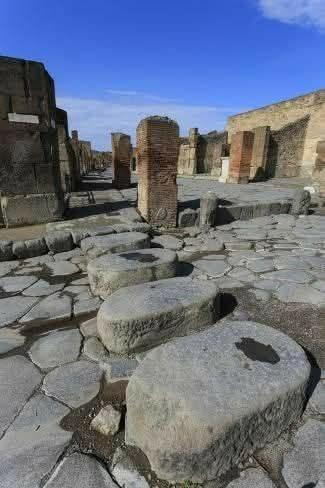
There’s a stretch of road in Pompeii that stops most visitors for a second longer than the guidebook suggests it should. Three big stone blocks sit across the width of the street, spaced just wide enough for a cart wheel to pass either side. Nobody put them there for looks. They’re, as far as anyone can work out, among the earliest pedestrian crossings still standing anywhere in the world, and the reason they exist says a lot about how the town actually worked.
Why the Streets Needed Them
Pompeii never built an underground sewer network. The street did that job instead. Rainwater, household water, the ordinary run-off of a working town, it all moved along the centre of the road rather than under it, and at night certain streets were deliberately flushed to clear them out. For a while, the road became something closer to a shallow stream. Crossing it meant using the stones. There wasn’t really another option.
It’s worth picturing a Roman street a bit differently to how we’d picture one now. It wasn’t only a route from one place to another, it was doing the work a drain does today, and the stones let ordinary life carry on above all that. Someone heading out for bread. Someone walking to the baths. None of it required wading through whatever the road happened to be carrying that particular morning.


What the Ruts Reveal
Look properly at the paving and you’ll find grooves worn deep into the stone, left by generation after generation of cart wheels. Roman carts had no articulated front axle, nothing that allowed a sharp turn, so the ruts more or less did the steering, holding each wheel on a fixed line much the way a rail guides a train.
Here’s the detail I find genuinely surprising. The gap between one set of stepping stones and the next followed a standard width across the whole Roman world. A cart built and loaded in Ostia would fit the crossing in Pompeii with zero adjustment. Someone arriving from a completely different town could trust the width of that gap before they’d even laid eyes on it. And because every driver had to slow right down to line the wheels up, the crossing point itself turned into one of the safer spots on the street for anyone on foot, almost as a side effect rather than by design.
Finding a Way Home After Dark
Somebody had thought about night time too. Small pieces of pale stone, marble here and there, sit set into the darker volcanic paving along a few routes. Catch them under moonlight and they’d have picked up whatever light was going, enough to mark a rough line for anyone walking home late. Most people miss it completely. I nearly did, on my first visit, until a guide pointed at the ground and asked what colour I thought that particular stone was.

Herculaneum Tells a Different Story
A few miles up the coast sits Herculaneum, buried by the same eruption, same year, same volcano. Walk its streets and you won’t find nearly as many stepping stones. Ask why and the answer has nothing to do with cleverness or design. Herculaneum simply had more money. It had already paid for an underground sewer system by the time Vesuvius went up, so its streets were never carrying waste water down the middle in the first place, and nobody needed a stone block to hop across on.
So you end up with two towns, a short walk apart, that solved the same daily problem in completely different ways, largely because one town could afford a solution the other couldn’t. The stones in Pompeii are still sitting there now, worn smooth, marking out exactly where people used to stop, look both ways, and cross.