The Genius of Ennio Morricone
In addition to being an excellent read, this article may contain links promoting Amazon products we believe in. As an Amazon Associate, we earn from qualifying purchases. Privacy policy.
In the pantheon of film composers, few names resonate as profoundly as Ennio Morricone. A musical alchemist who transformed the landscape of cinema with his innovative scores, Morricone’s career spanned over six decades, leaving an indelible mark on the world of film and music alike. From the dusty landscapes of Spaghetti Westerns to the intimate chambers of arthouse cinema, his compositions have become inseparable from the visual narratives they accompany.
The Early Years: A Prodigy in the Making
Born in Rome on November 10, 1928, Morricone’s musical journey began in the crucible of post-war Italy. The son of a jazz trumpeter, young Ennio was immersed in music from an early age. By six, he was already penning his first compositions, a precocious talent that would blossom into genius. The streets of Rome, still echoing with the remnants of conflict, would later infuse his work with a visceral understanding of tension and release.
In 1946, at the tender age of 18, Morricone composed “Il Mattino” (“The Morning”), a piece that hinted at the emotive power he would later wield in his film scores. These early works, steeped in the classical tradition, laid the foundation for a career that would defy categorization.
The Spaghetti Western Revolution
It was in the 1960s that Morricone’s star truly began to rise. His collaboration with former schoolmate Sergio Leone on “A Fistful of Dollars” (1964) marked the beginning of a partnership that would redefine the Western genre. Morricone’s score, with its iconic whistling, whip cracks, and twanging guitars, was as revolutionary as Leone’s gritty visuals.
The pinnacle of this collaboration came with “The Good, the Bad and the Ugly” (1966). The main theme, with its haunting melody and innovative use of vocals mimicking coyote howls, became instantly recognizable worldwide. This score didn’t just accompany the film; it became an integral part of the storytelling, elevating the cinematic experience to new heights.
Beyond the West: A Versatile Genius
While the Spaghetti Westerns cemented Morricone’s reputation, they were merely the opening act in a career of astounding versatility. His ability to adapt to different genres while maintaining his distinct voice set him apart from his contemporaries.
In “Days of Heaven” (1978), Morricone’s lush, romantic score earned him his first Oscar nomination, proving his ability to craft delicate, emotive pieces that contrasted sharply with his earlier, more bombastic work. The 1980s saw him tackle diverse projects, from the haunting synth-laden score of John Carpenter’s “The Thing” (1982) to the sweeping orchestral arrangements of “Once Upon a Time in America” (1984).
The Mission: A Masterpiece of Cultural Fusion
Perhaps no score better exemplifies Morricone’s genius than his work on Roland Joffé’s “The Mission” (1986). Here, Morricone seamlessly blended European classical traditions with indigenous South American rhythms, creating a soundscape that was both historically authentic and emotionally transcendent. The main theme, “Gabriel’s Oboe,” has become one of the most beloved pieces in film music history, its plaintive melody capturing the film’s themes of faith, colonialism, and redemption.
Exploring the Boundaries of Music
What set Morricone apart was not just his melodic gift but his willingness to experiment. As a member of the avant-garde collective Gruppo di Improvvisazione di Nuova Consonanza, he explored the boundaries of music, incorporating unconventional sounds and techniques into his compositions.
This experimental streak found its way into his film scores, where Morricone would often use everyday objects to create unique sound effects. In “The Good, the Bad and the Ugly,” the sound of howling coyotes was actually created by Italian session singers. This blend of the familiar and the avant-garde became a Morricone trademark, allowing him to create soundscapes that were both accessible and artistically daring.
Italy’s Prolific Music Producer
The sheer volume of Morricone’s output is staggering. With over 500 film and television scores to his name, not to mention his work in popular music and concert halls, Morricone’s productivity was matched only by his consistency. From intimate dramas to sweeping epics, he approached each project with the same level of dedication and artistry.
His collaborations read like a who’s who of cinema: Sergio Leone, Terrence Malick, Brian De Palma, Giuseppe Tornatore, and Quentin Tarantino, to name but a few. Each partnership brought out different facets of Morricone’s talent, showcasing his ability to adapt to various directorial styles while maintaining his unique voice.
Finally, A Long-Overdue Oscar
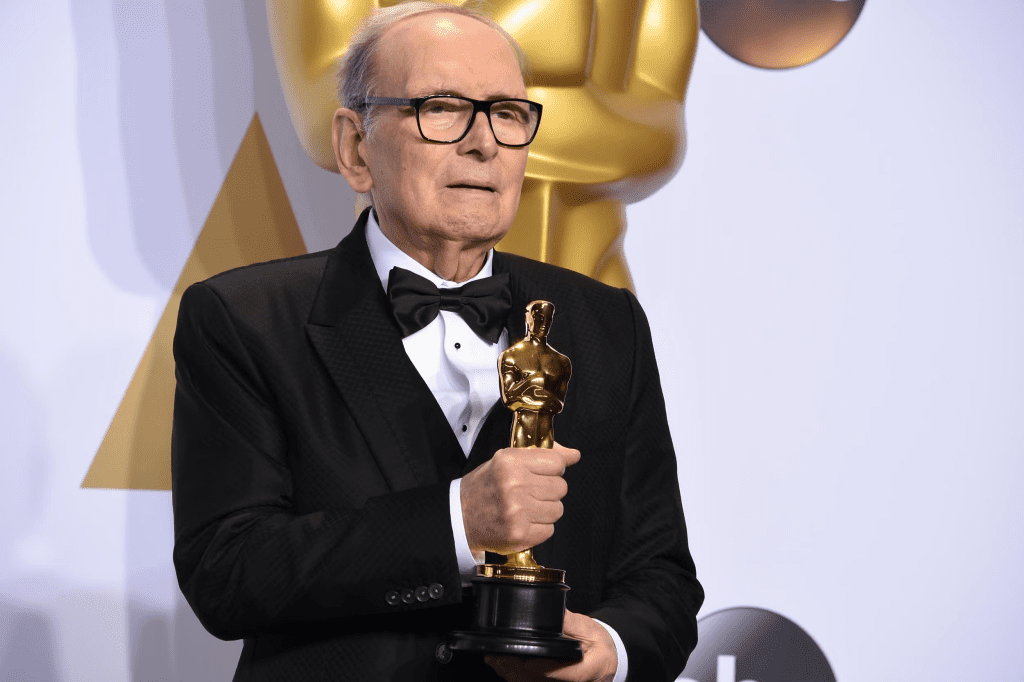
Despite his undeniable impact on cinema, official recognition was slow in coming. Morricone received his first competitive Oscar only in 2016, at the age of 87, for his score to Quentin Tarantino’s “The Hateful Eight”. This belated acknowledgment came after five previous nominations and an honorary Oscar in 2007 for his “magnificent and multifaceted contributions to the art of film music.”
Yet, awards were never the measure of Morricone’s success. His true legacy lies in the emotional resonance of his music, its ability to elevate the visual medium and touch the hearts of audiences worldwide.
Defining Elements of Morricone’s Sound
What made a Morricone score instantly recognizable? Several key elements defined his approach:
- The use of a persistent pulse or ostinato, creating a sense of momentum and tension.
- Layering of contrasting timbres, often combining traditional orchestral instruments with unconventional sound sources.
- A masterful use of simple triads and intervals, manipulated to create complex emotional landscapes.
- The incorporation of human voices as instruments, from whistling to wordless choirs.
- 5. A willingness to blend genres and styles, creating unique sonic palettes for each film.
These elements, combined with Morricone’s innate sense of melody and drama, created a sound that was both distinctly his and infinitely adaptable to the needs of each film.
Always A Humble Genius
Despite his towering achievements, Morricone remained remarkably humble throughout his career. He insisted on writing every note himself, eschewing arrangers and computer software in favor of pen and paper. This hands-on approach ensured that each score bore his personal touch, a level of craftsmanship that became increasingly rare in the digital age.
Morricone’s work ethic was legendary. He rose early each morning to compose, maintaining a disciplined routine well into his later years. This dedication allowed him to maintain a prodigious output while never compromising on quality.
Everlasting Legacy and Influencer
Ennio Morricone passed away on July 6, 2020, leaving behind a body of work that will continue to inspire and move audiences for generations to come. His influence extends far beyond the world of film music, touching popular culture, classical composition, and even avant-garde experimentation.
Musicians across genres have cited Morricone as an influence, from rock bands like Metallica to classical virtuosos. His ability to create memorable themes that stand on their own as pieces of music, separate from their films, is a testament to his genius.
In the end, what makes Morricone’s music endure is its emotional honesty. Whether scoring a tense standoff in a Western or a moment of spiritual epiphany, his compositions speak directly to the heart, transcending language and cultural barriers.
The Documentary: “Ennio”
Rent via Prime

In 2021, director Giuseppe Tornatore released “Ennio,” a comprehensive documentary that delves deep into the life and work of this musical maestro. The film offers an intimate look at Morricone’s creative process, featuring interviews with the composer himself as well as testimonials from renowned directors and musicians who worked with him or were influenced by his music.
“Ennio” takes viewers on a journey through Morricone’s career, from his early days as a trumpet player to his rise as one of the most sought-after film composers in the world. The documentary showcases rare archival footage, behind-the-scenes glimpses of Morricone at work, and explores the cultural impact of his most iconic scores.
This film serves not only as a tribute to Morricone’s genius but also as an educational tool for aspiring composers and film enthusiasts. It offers insights into the collaborative nature of film scoring and the unique challenges and rewards of this art form.
Exploring Morricone’s Legacy: Books and Music
For those wishing to delve deeper into Morricone’s life and work, several books offer valuable insights:
1. “Ennio Morricone: In His Own Words” – This collection of interviews with the maestro himself provides a firsthand account of his creative process and philosophy.

2. “ENNIO MORRICONE: ANTHOLOGY” – Anthology for Piano and Guitar of the Most Famous Works by Ennio Morricone, paperback. The list celebrates Morricone’s exceptional contributions to film scores, showcasing works across iconic movies and genres.

3. “Composing for the Cinema: The Theory and Praxis of Music in Film” by Ennio Morricone and Sergio Miceli – A technical exploration of film scoring, offering invaluable insights for aspiring composers.

Music lovers can explore Morricone’s vast catalog through various compilations and original soundtracks available on streaming platforms and physical media:

“Morricone 60” on vinyl – A collection of Morricone’s most iconic themes, newly recorded with the Czech National Symphony Orchestra.

“The Ennio Morricone Anthology: A Fistful of Film Music” – A comprehensive 3-CD set spanning Morricone’s career.

Original Soundtracks on vynl – From “The Good, the Bad and the Ugly”

to “The Mission”

and “Cinema Paradiso,”

Many of Morricone’s individual film scores are available as standalone albums.
The Genius Remains Accessible
Ennio Morricone was more than a composer; he was a storyteller in sound, a maestro who could evoke entire worlds with a few notes. His passion for music, his innovative spirit, and his unwavering commitment to his art have left an indelible mark on the landscape of cinema. As the final notes of his remarkable career fade, we are left with a legacy that will continue to resonate through the annals of film history, a testament to the power of music to move, to inspire, and to transform.
Through documentaries, books, and his vast musical catalog, Morricone’s genius remains accessible to new generations of film lovers and music enthusiasts. His work continues to inspire, educate, and entertain, ensuring that the maestro’s voice will be heard for many years to come.