Il Mostro (The Monster of Florence), directed by Stefano Sollima, written by Sollima with Leonardo Fasoli. Four episodes, streaming on Netflix.
What the series is about, for anyone who has not watched it
Between 1968 and 1985, eight couples were attacked in the countryside around Florence. Sixteen people died. The killer was never conclusively identified, and in Italy the case is known simply as il Mostro di Firenze.
The pattern was consistent enough to terrify a city. Couples parked at night on unlit lanes at the edge of farmland, within a ring roughly fifteen to thirty kilometres from the centre of Florence. Signa in 1968. Borgo San Lorenzo in 1974. Scandicci and Calenzano in 1981. Montespertoli in 1982. Giogoli in 1983. Vicchio in 1984. San Casciano in 1985. Look at those names on a map and the shape of the case appears immediately, a loose circle drawn around the city.
Sollima’s four part series takes an unusual approach to this material. It largely declines to be a detective story. Instead it follows what Italian investigators came to call the pista sarda, the Sardinian trail, which begins with that first killing in Signa in 1968 and the extended family of Sardinian immigrants connected to it. The series spends its time with those families, in their houses and their kitchens and their cars, rather than with the magistrates trying to catch someone.
That decision is why the landscape matters so much. If the series were a procedural it would live in offices. Because it is a story about families spread across a specific piece of country, the country itself carries the narrative, and the locations were chosen with that job in mind.
Three prosecutions eventually followed, in the nineteen nineties, on evidence that remains heavily contested. The case is formally unsolved.
Watch the trailer:
The Monster of Florence | Official Trailer | Netflix
Why these hills
Sollima has never treated landscape as decoration. Gomorrah made Scampia a protagonist. ZeroZeroZero used the flatness of northern Mexico and the fog of Calabria as narrative devices. With Il Mostro he faced a harder problem, because the Florentine countryside carries four hundred years of accumulated prettiness, and every instinct a viewer brings to Tuscany works against what this series needs the place to feel like.
The Florentine hinterland is shot almost entirely at the hours when it stops being decorative. Mist in the vine rows at first light. The half hour after sunset when olive terraces go flat and colourless. Full night on provincial roads with no lighting at all, where a single parked car is the only light source for a kilometre.
There is also a piece of social history that the series adopts but doesn’t explain. Young Italians in the nineteen seventies had nowhere private to go. Housing was tight, families were large, and the car arrived considerably faster than any corresponding social liberalisation. So couples drove out of the city and parked on unlit lanes at the edge of the fields for romantic encounters and private conversations. Every Italian city had its version of this and Florence’s version was these ridges.
That is the tour. Not crime scenes, but the specific band of working farmland that a generation of Florentines used as its only private space, and which a director then shot as something else entirely. Location roundups tend to list the places. What follows tries to explain them.
Day One in Florence, the city of the investigation
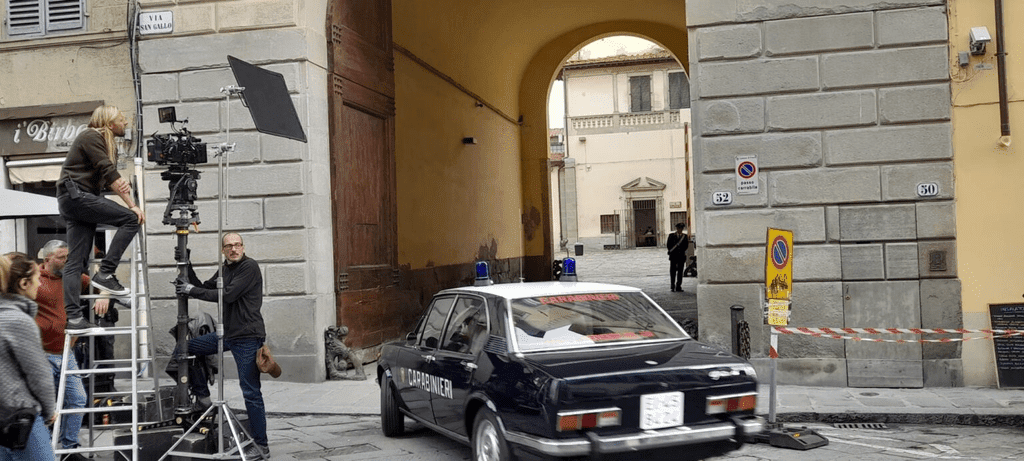
The killings happened in the countryside. Everything institutional happened inside a rectangle of central Florence about six hundred metres across, and the series stays in that rectangle for most of its interior work.
Piazza San Firenze is the anchor. The baroque complex on the eastern side held the Florence courts from the nineteenth century until 2012. For any Italian who followed the case, this facade simply is the case, the way the Old Bailey is for British readers. Sollima frames it the way Italian directors have framed courthouses since the Years of Lead, as architecture that dwarfs whoever is standing in front of it.
Note what the production did not have to do here, which is dress the square heavily. It needs almost nothing to read as 1985, and that is the location scout’s real problem in central Florence. The stone has not moved in five hundred years, so all the period work sits in the thin modern layer on top of it. Shopfronts, signage, street furniture, parked cars, road markings. A Florentine street is castable for a period shoot in inverse proportion to how much retail it carries, which is why Via dei Gondi and Via del Proconsolo work and Via dei Calzaiuoli never could. Those two are corridors rather than streets, high blank palace walls, almost no ground floor windows, nothing to remove.
Via San Gallo, further north, gives the production the other thing it needs, which is a Florence where people simply live. Ordinary blocks, neighbourhood bars, no visitors. The old Corte d’Appello sits among them without ceremony.
La Nazione followed the unit through the city while it worked, which is the closest thing to a street by street record of what was shot where. A detailed breakdown of the central locations is also available for anyone building their own route.
Why go
Because this is the Florence that exists underneath the tourist city, and three hours of walking will teach you more about how Florentines actually live than a week of galleries. The centre empties out around seven in the evening, when the day visitors return to their coaches, and for about an hour the streets belong to the people who live in them.
Where to stay
- Hotel Brunelleschi, built into a Byzantine tower on Piazza Santa Elisabetta, roughly five minutes from Piazza San Firenze. The tower is the oldest standing structure in the city centre.
- Hotel Calimala, a smaller and more contemporary option near the Mercato Nuovo, with a rooftop terrace that looks across to the Duomo.
- Palazzo Vecchietti, a suites only property in a sixteenth century palazzo, quieter and more discreet than either of the above.
Where to eat
- Buca dell’Orafo, a genuine buca tucked below street level near Ponte Vecchio, serving Florentine standards to a largely local room.
- Trattoria Cammillo, on the Oltrarno side, family run since the nineteen forties and a fixture of Italian rather than international guidebooks.
- Osteria Vini e Vecchi Sapori, tiny, handwritten menus, and directly behind Palazzo Vecchio. Book ahead, because there are barely twenty covers.
Getting there
The historic centre is walkable end to end in twenty minutes. From Peretola, the T2 tram runs to Unità in around twenty minutes and costs a fraction of a taxi.
Day Two on the Via Bolognese and into the Mugello
The Via Bolognese is the old road to Emilia, and it climbs from the moment it leaves Piazza della Libertà. Ten minutes out the villas thin, the road narrows into switchbacks, and Florence becomes something you look down at.
The cemetery of Trespiano sits on this road at number 449. It was opened in 1784 under the Habsburg Lorraine sanitary reforms, when burial inside the city walls was banned, and it became the principal burial ground for Florence. It is not to be confused with the English Cemetery at Piazzale Donatello, the Protestant burial ground inside the city where Elizabeth Barrett Browning lies, which is a different place entirely and frequently confused with this one.

Architecturally Trespiano is a monumental cemetery of the standard Italian type, which means long straight avenues with cypress at regular intervals, producing a receding perspective that makes a human figure very small and gives no sense of how far away the end is. That is almost certainly why the production wanted it. It is a shot that does specific narrative work before anyone in it says a word.
It remains a working municipal cemetery in daily use by Florentine families. Go quietly and go early.
North of there the road crosses into the Mugello and the terrain changes completely. Chestnut woods rather than olive terraces, cooler air, a wide valley floor, working farms. This side of Florence matters to the story because two of the attacks, in 1974 and 1984, happened at Borgo San Lorenzo and Vicchio, and the series therefore needs a landscape that reads as a different country from the southern ridges. It gets one. The Mugello feels Apennine rather than Tuscan, and the tonal shift on screen is real.
Borgo San Lorenzo is the market town, with a Liberty era ceramics tradition from the Chini manufactory and essentially no visitor economy. Vicchio was the birthplace of Fra Angelico.
Why go
Because the Mugello is one of the last parts of the province of Florence that has not been rearranged for visitors, and because the drive itself, roughly forty minutes each way, is among the best in Tuscany.
Where to stay
If you would rather sleep in the valley than return to the city:
- Villa Campestri Olive Oil Resort near Vicchio, a fifteenth century villa on a working olive estate, with a serious focus on oil production.
- Locanda Senio at Palazzuolo sul Senio, further into the hills, small and family run.
- Alternatively, remain in Florence and treat this as a day trip, which is what most readers will do.
Where to eat
- Ristorante degli Artisti in Borgo San Lorenzo, a long standing local address on the main square.
- Any of the agriturismi signposted between Borgo San Lorenzo and Vicchio, most of which serve what they grow and open only at weekends outside summer.
Getting there
By car, the SP65 north from Florence. Driving directions to Trespiano put it around fifteen minutes from the centre in ordinary traffic. Without a car, the Faentina railway line runs from Santa Maria Novella to Borgo San Lorenzo in around fifty minutes and is one of the prettier regional lines in Italy. Trespiano itself is served by ATAF bus from the city centre.
Day Three in Signa and the Val di Pesa
This is where the story starts. In August 1968 a couple were shot dead in a parked car on a lane outside Signa, a small town near the confluence of the Arno and the Bisenzio. At the time it was treated as a domestic killing, and a man was convicted of it. Only in 1982, when ballistics linked the same pistol to a chain of later attacks, did that first case reopen and the pista sarda begin. The series takes this as its starting point and its organising thread.
Signa itself is worth an hour on its own terms. It has a genuine industrial history in straw plaiting, which supplied hats across Europe for a century, and a compact centre with almost no visitors.

South of the river the Val di Pesa opens out into the ridges. San Casciano holds the medieval core and the views in three directions, and it sits at the centre of the case geography, close to both Scopeti and Sant’Andrea in Percussina. Mercatale and Montespertoli are further in, and the drive along the ridge between them is the point of the day. Machiavelli wrote Il Principe at Sant’Andrea in Percussina, and the inn where he drank with the locals is still standing and still serving.
Drive it in the ninety minutes before sunset, which is exactly the light the series uses here, and the reason the country looks the way it does on screen. If you want to build the day around eating rather than driving, Cinefood Italia has mapped the Tuscan locations against the local table, which is a more Italian way to approach the same ground.
Why go
Because this is Chianti before Chianti became a brand, fifteen minutes from Florence, and because the wine here is genuinely good and considerably less expensive than it is thirty kilometres south.
Where to stay
- Fattoria Le Corti at San Casciano, the Corsini family estate, with rooms among the vines and tastings in the cellars.
- Villa Il Poggiale, a Renaissance villa turned country hotel with long views over the valley.
- Antinori nel Chianti Classico at Bargino is not a hotel, but the winery architecture alone justifies an hour of anyone’s afternoon.
Where to eat
- La Tenda Rossa at Cerbaia, long established and considerably more ambitious than its village setting suggests.
- Albergaccio del Machiavelli at Sant’Andrea in Percussina, in the building attached to Machiavelli’s house.
- Nonna Giulia in San Casciano for something simpler and more everyday.
Getting there
Twenty five to forty minutes from Florence by car depending on the route. The Florence to Siena superstrada exits at San Casciano. Signa is on the regional railway line from Santa Maria Novella, around fifteen minutes.
A closing note
The case is formally unsolved. Three men were prosecuted in the nineteen nineties on contested evidence, one died in prison, and there are families in Florence and Signa who have lived inside this story for nearly sixty years. Visitors who arrive looking for the roadsides where the killings happened are not welcome, and local feeling about this is sharper than most outsiders expect.
What is worth travelling for is the country. Sollima found something in these hills that decades of Tuscan tourism marketing had flattened out, and going to look at it properly is a reasonable use of three days.
If you are driving on to Rome afterwards, Ronciglione is a handsome hill town on the Cimini lakes, and a few scenes of the production were shot there too.