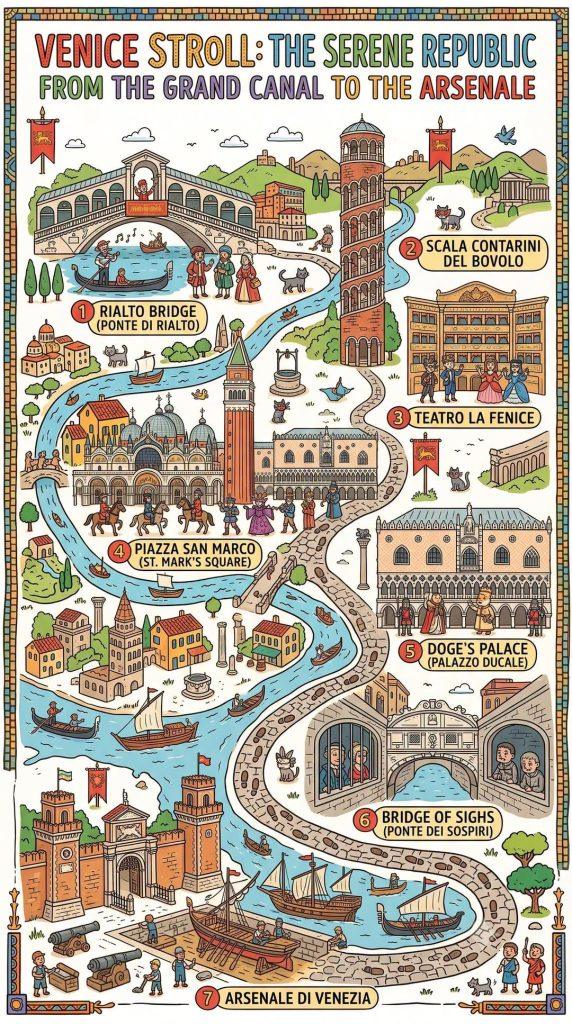
The Serene Republic A Self-Guided Walk from the Grand Canal to the Arsenale
This article was adapted from original ideas published on Visit Naples and Amalfi coast Travel tips.
Venice is a city best understood on foot. Beyond its celebrated canals and grand palaces lies a maze of narrow streets, quiet courtyards and stone bridges that reveal the history of the former Venetian Republic one corner at a time.
This self-guided walk begins at the Rialto Bridge and continues through San Polo, San Marco and Castello, following a route of around 3.5 kilometres towards the Arsenale. The walking itself takes roughly 50 minutes, although allowing four to five hours gives you time to explore the landmarks, pause for cicchetti and occasionally lose yourself among Venice’s winding streets.
Comfortable shoes are essential, particularly for the many bridges and steps along the way. An offline map is also useful, although getting slightly lost is part of the experience.
Rialto Bridge
The walk begins at the Rialto Bridge,the oldest surviving bridge across the Grand Canal and one of Venice’s most recognisable landmarks.
The present stone bridge was completed in 1591, replacing earlier wooden structures that had collapsed over the centuries. Its single sweeping arch and covered arcades became an enduring feature of the Venetian landscape, while the surrounding Rialto area developed into the commercial heart of the Republic.
The bridge’s design was once viewed with considerable scepticism. Antonio da Ponte, the local architect chosen for the project, faced criticism from those who doubted whether such a large single arch could withstand the demands placed upon it. Centuries later, the bridge remains one of Venice’s defining architectural achievements.
From the centre of the bridge, take a moment to watch the traffic of boats moving along the Grand Canal before leaving the busy waterfront behind.
Scala Contarini del Bovolo
The route then winds through a quieter part of Venice towards the Scala Contarini del Bovolo, a remarkable Renaissance staircase tucked away within a small courtyard.
Built in the late fifteenth century, the structure combines Gothic, Renaissance and Byzantine influences. Its series of rounded arches rises in a graceful spiral beside the Palazzo Contarini, creating one of the city’s more unusual architectural landmarks.
The Venetian word bovolo means snail, a reference to the staircase’s distinctive shape. Local tradition also tells of Pietro Contarini, who supposedly commissioned the staircase so that he could reach his private quarters with greater ease. Like many stories attached to Venice’s historic buildings, the tale has become part of the character of the place.
Teatro La Fenice
From here, continue towards Teatro La Fenice, one of Italy’s most important opera houses.
Opened in 1792, La Fenice has played a central role in the history of Italian opera, hosting important performances and premieres associated with composers including Giuseppe Verdi, Gioachino Rossini and Vincenzo Bellini.
Its name, meaning “the phoenix”, has proved remarkably fitting. The theatre suffered devastating fires and was rebuilt several times, most recently following the fire of 1996. Each reconstruction returned La Fenice to Venice’s cultural life, continuing a story of resilience that has become inseparable from the theatre itself.
Piazza San Marco
The narrow streets eventually open into Piazza San Marco, Venice’s grandest public space.
For centuries, the square has served as the centre of Venetian political, religious and social life. St Mark’s Basilica dominates one side with its Byzantine mosaics and distinctive domes, while the Campanile rises above the square as one of the city’s most recognisable landmarks.
At the edge of the piazza, two monumental granite columns stand beside the lagoon. They are traditionally associated with Venice’s patron saints, Saint Mark and Saint Theodore.
There was once a third column. According to the longstanding story, it fell into the lagoon during its installation and disappeared beneath the water. Despite later attempts to locate it, the missing column has never been recovered.
Doge’s Palace
Beside the basilica stands the Doge’s Palace, a magnificent example of Venetian Gothic architecture and one of the most important buildings in the history of the Republic.
For centuries, it served as the residence of the Doge as well as the centre of Venetian government. Behind its elegant exterior were council chambers, administrative offices, courts and places of detention, reflecting the complex political system that allowed Venice to govern its territories across the Mediterranean.
Look carefully around the exterior for the carved stone faces known as Bocche di Leone, or Lion’s Mouths. These served as anonymous boxes where citizens could submit accusations concerning matters such as corruption, tax evasion or other offences.
The elegant façade therefore concealed a government shaped by a surprisingly sophisticated system of administration and surveillance.
The Bridge of Sighs
Continue along the waterfront towards the Bridge of Sighs.
Built in 1600, the enclosed limestone bridge connects the Doge’s Palace with the former prison across the canal. Its ornate appearance makes it one of Venice’s most photographed landmarks, although its original purpose was far less romantic.
The name “Bridge of Sighs” became associated with the poet Lord Byron, who imagined prisoners catching their final glimpse of Venice through the small stone windows as they were led towards their cells.
Today, the bridge forms part of the city’s romantic image, yet its history offers a reminder of the darker side of life within the Venetian Republic.
The Arsenale
The final section of the walk follows the waterfront into the Castello district and towards the Arsenale.
Founded during the twelfth century, the Venetian Arsenal became the centre of the Republic’s maritime power. Its vast complex contained shipyards, workshops and storage facilities where vessels were built and equipped for Venice’s extensive trading and military network.
The organisation of the Arsenal was extraordinary for its time. Standardised components and specialised workers allowed ships to be assembled with an efficiency that impressed visitors from across Europe. The system has often been compared with an early form of industrial production, centuries before the modern factory.
Reaching the Arsenal brings the walk to a fitting conclusion. Beginning beside the commercial heart of the Grand Canal and ending at the shipyards that supported Venice’s maritime ambitions, the route traces an important part of the story that made the city one of Europe’s great powers.
Venice Beyond the Grand Canal
The beauty of Venice lies partly in the spaces between its famous landmarks. A walk through the city reveals grand palaces alongside modest courtyards, busy squares beside quiet canals and centuries of history woven into everyday life.
From Rialto to the Arsenale, this route offers a glimpse into the many sides of the Venetian Republic. Take your time, follow the smaller streets when they invite you in, and leave room for the unexpected. In Venice, getting slightly lost can often be part of finding the city itself.