A Local’s Walking Route Through Pompeii in Three Hours
This article was adapted from original ideas published by Visit Naples and Amalfi Coast Travel Tips.
Every time I visit Pompeii, I’m reminded that this was once a thriving Roman city, and nearly every street, house, and public building has a story to tell. I also see many visitors trying to explore it without a plan, only to realise later they’ve missed some of its most fascinating places.
If you have around three hours, this is the route I recommend. It takes in Pompeii’s most famous landmarks while giving you time to appreciate the remarkable details that bring this ancient city back to life.
Before you begin, one quick note about the accompanying map. It’s intended as a visual guide rather than an exact scale map. During your visit, simply follow the route below for an easy and enjoyable walk through the site.
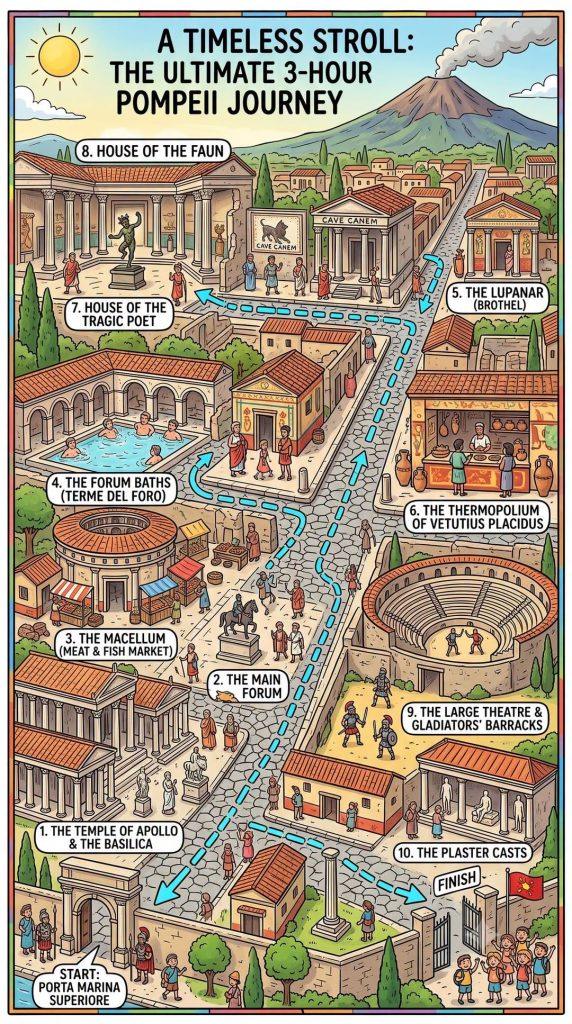
Planning your visit
This walk covers around 2.5 to 3 kilometres and is suitable for couples, families, solo travellers, and anyone with an interest in history.
I recommend entering through Porta Marina Superiore, which leads directly into Pompeii’s main public and religious district without unnecessary backtracking.
The best time to visit is early in the morning, around 9:00am, or later in the afternoon after 3:00pm when temperatures are cooler and the crowds begin to thin.
Wear comfortable closed-toe shoes because the ancient streets are uneven. Bring sun protection, a reusable water bottle that you can refill at the fountains throughout the site, and a physical photo ID if your ticket requires verification.
Begin at Porta Marina Superiore
Starting at Porta Marina Superiore makes exploring Pompeii much easier. This ancient gateway leads directly towards the Forum, allowing you to follow a natural route through the city’s most important landmarks without retracing your steps later. It’s a simple choice that makes the entire visit feel far more relaxed.
Explore the Temple of Apollo and the Basilica
As you make your way uphill, your first stop is the Temple of Apollo, one of Pompeii’s oldest and most important religious sites. Take a moment to admire the bronze statues of Apollo and Diana before continuing next door to the Basilica.
A favourite detail I point out is the graffiti carved into the Basilica’s walls. Nearly two thousand years ago, the people of Pompeii were already leaving messages for one another. Some complained about disappointing meals, others wrote about romance, while many celebrated the victories of their favourite gladiators. So not very different from our own thoughts, comments and messages of today.
Stand in the heart of the Forum
The Forum was the centre of daily life in Pompeii, where politics, religion, business, and social life all came together.
As you explore the square, do remember to look at the large stepping stones crossing the nearby streets. These acted as ancient pedestrian crossings, allowing people to avoid mud, rainwater, and animal waste while Roman chariots passed neatly between them. Such a brilliant example of the practical thinking that shaped everyday life in the Roman world.
Step inside the Macellum
On the north-eastern side of the Forum you’ll find the Macellum, Pompeii’s main food market.
Fish, meat, and fresh produce were sold here every day, making it one of the busiest places in the city.
Interestingly, archaeologists made an extraordinary discovery while excavating the drainage system beneath the market. Alongside fish bones, they uncovered the remains of flamingos and even giraffes. These finds reveal that wealthy Romans imported exotic foods from across the empire, often serving unusual dishes simply to impress their guests.
See Roman engineering at the Forum Baths
The Forum Baths offer a fascinating insight into Roman engineering and daily life.
The beautifully preserved stucco decoration immediately catches your attention, but the clever design is even more impressive. The baths were heated by an advanced underfloor heating system, while the ridged ceilings helped trap steam and prevented cold condensation from dripping onto bathers.
It’s another wonderful reminder that Roman architecture was designed to be both practical and elegant.
A glimpse into everyday life at the Lupanar
Pompeii’s most famous brothel offers an honest look at another side of Roman society.
Inside you’ll still find the original stone beds and colourful frescoes painted above each doorway. These images acted as simple visual menus, allowing customers to choose the services they wanted.
The name Lupanar comes from the Latin word lupa, meaning she-wolf, which was also used as slang for a prostitute. Look closely and you’ll still see graffiti scratched into the plaster by former clients, leaving behind personal comments that have survived for centuries.
Pompeii’s ancient street food
As you continue along the ancient streets, you’ll come across the Thermopolium of Vetutius Placidus, one of Pompeii’s best-preserved street food shops.
Meals and hot drinks were served from large terracotta jars built directly into the stone counter, making it the Roman equivalent of a takeaway café.
When archaeologists excavated the site, they found an astonishing 1,385 bronze coins hidden inside one of the jars. It’s believed the owner tried to hide the day’s earnings as the eruption began but never had the chance to return.
The House of the Tragic Poet
This elegant Roman home is famous for one of Pompeii’s best-known mosaics.
At the entrance you’ll find the image of a chained dog with the words Cave Canem, meaning Beware of the Dog.
The house later inspired Edward Bulwer-Lytton’s bestselling novel The Last Days of Pompeii, helping introduce the ancient city to readers around the world during the nineteenth century.
Inside the House of the Faun
The House of the Faun is one of Pompeii’s grandest private residences, occupying an entire city block and covering around 3,000 square metres.
Named after the bronze statue of a dancing faun in its courtyard, the house once displayed the magnificent Alexander Mosaic, created from more than one million tiny tiles. The workmanship was so detailed that it looked almost like a painting.
Even today, it remains one of the finest examples of Roman domestic architecture and offers a remarkable glimpse into the wealth enjoyed by Pompeii’s elite.
End your walk in Pompeii’s entertainment district
From here, make your way to Pompeii’s entertainment quarter, where the Large Theatre once welcomed around 5,000 spectators for plays and public performances.
Behind the stage stands the Quadriporticus, later used as the gladiators’ barracks. One discovery here has fascinated historians for years. Archaeologists uncovered the skeleton of a wealthy aristocratic woman lying beside that of a gladiator, sparking endless speculation about who they were and what brought them together during the eruption.
Even by today’s standards, the theatre itself is equally impressive. Thanks to its remarkable acoustics, even a quiet voice spoken on stage can still be heard from the highest rows.
Witness Pompeii’s final moments
I always finish my visit by seeing the famous plaster casts of the victims.
These aren’t sculptures. They were created by filling the empty spaces left in the hardened volcanic ash after the victims’ bodies had decomposed, preserving their final moments with remarkable accuracy.
Recent CT scans of several casts have revealed something unexpected. Many of Pompeii’s residents had exceptionally healthy teeth, thanks to their Mediterranean diet and the naturally high fluoride content in the local water.
A moving reminder that Pompeii wasn’t simply a city destroyed by disaster. It was once home to thousands of ordinary people whose stories continue to be discovered today.
Continue your journey at the MANN
If you have time after visiting Pompeii, I recommend continuing to the National Archaeological Museum of Naples, better known as the MANN.
Many visitors don’t realise that some of Pompeii’s greatest treasures are displayed here rather than inside the archaeological park itself. The museum houses magnificent frescoes, intricate mosaics, bronze statues from the Villa of the Papyri, and many everyday objects recovered from both Pompeii and nearby Herculaneum, including the famous carbonised papyrus scrolls.
Visiting both sites gives you a much richer understanding of Roman life than either one alone.
Explore with an expert guide
Walking through Pompeii or the MANN without a guide is a little like watching a great film with the sound turned off. You can admire what you see, but it’s easy to miss the stories that make each place so extraordinary.
My team organises small group and private tours led by certified guides for Pompeii, Herculaneum, and the MANN. They’ll connect the streets you’ve explored with the remarkable artefacts displayed in the museum, bringing ancient Roman life into context.
If you’d like more information or would like to check availability, feel free to contact me directly.
My favourite tours and travel resources
If you’re planning a trip to Southern Italy, these are the resources I personally recommend.
Fast ferry tickets
If you’re travelling between Naples, Sorrento, Capri, Ischia, Procida, or the Amalfi Coast, I recommend booking both your outbound and return ferry tickets in advance, especially during the busy season.
https://www.ferryhopper.com/?aff_uid=vsnpamf
Best tours and tickets for Capri and Ischia
Discover my recommended tours, boat trips, and experiences for Capri and Ischia.
https://visitnaplesandamalficoasttraveltips.blogspot.com
Top Naples tours, Pompeii, Herculaneum and skip-the-line tickets
Find recommended tours, guided experiences, and skip-the-line tickets for Naples, Pompeii, and Herculaneum.
https://visitnaplesandamalficoasttraveltips.blogspot.com
Best Amalfi Coast and Sorrento tours
Planning to explore the Amalfi Coast or Sorrento? Here you’ll find my favourite tours and local experiences.
https://visitnaplesandamalficoasttraveltips.blogspot.com
Stay in the heart of Naples
If you’re spending a few days in Naples, I also host two top-rated Airbnb apartments just a short walk from Toledo Metro Station in the historic centre. They’re an excellent base for visiting Pompeii, Herculaneum, Capri, Ischia, Sorrento, and the Amalfi Coast.
Apartment 1
https://www.airbnb.com/rooms/4262320?guests=1&adults=1
Apartment 2
https://www.airbnb.com/rooms/836397423820889981?guests=1
If you’d prefer to avoid Airbnb service fees, feel free to contact me directly.
Let me help you plan your trip
Whether you’re looking for private airport transfers, guided tours, private drivers, boat excursions, logistics, or help with ticket reservations and skip-the-line services, my team and I are always happy to help.
I hope this route helps you experience Pompeii at a slower pace and appreciate the incredible stories hidden behind its ancient streets. It’s one of those places I never get tired of visiting, and every walk reveals something new.